
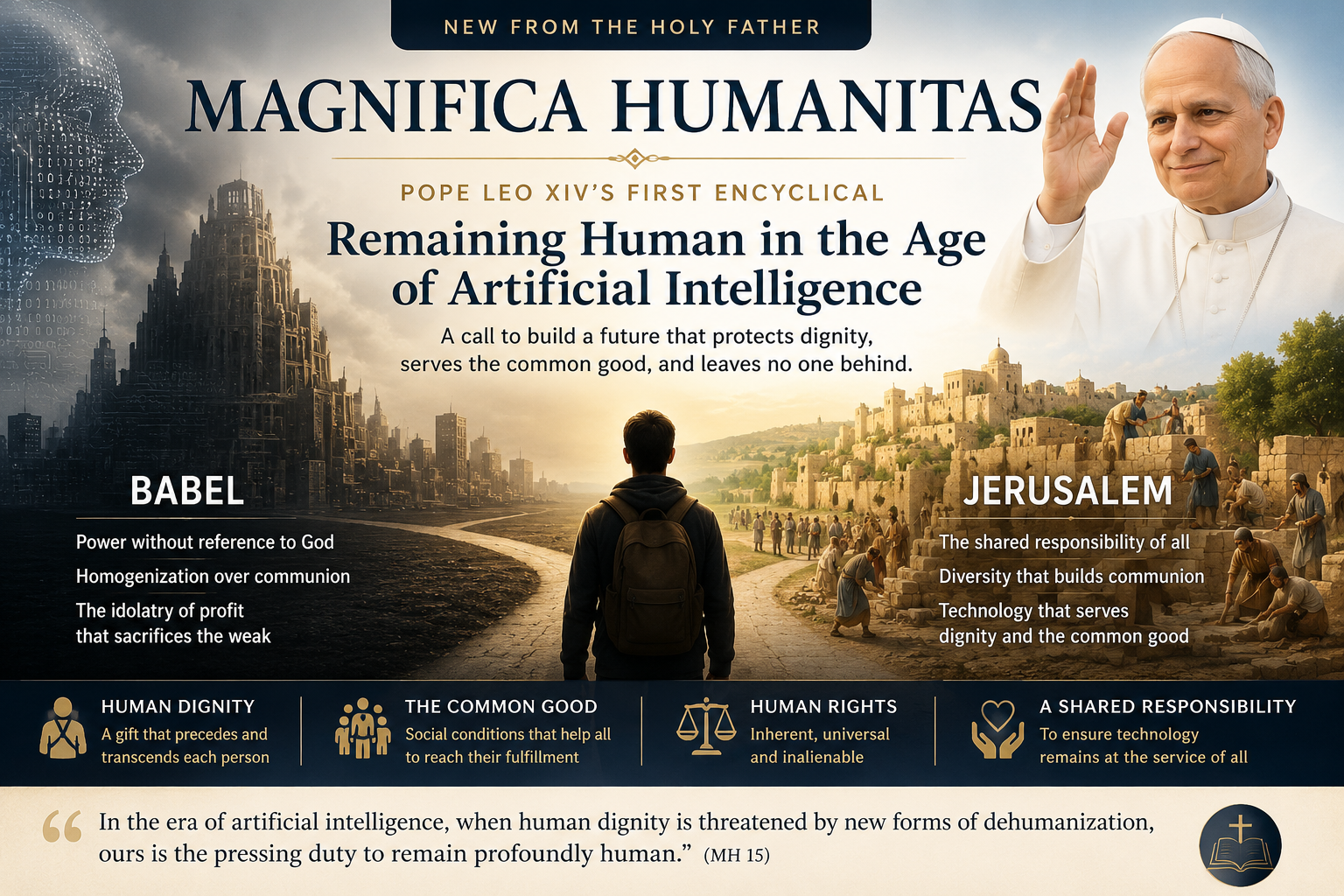
A Reflection on Pope Leo XIV’s First Encyclical
Artificial Intelligence is rapidly changing our world. It influences the way we communicate, learn, work, shop, travel, and even make decisions. Many people welcome these developments with enthusiasm, while others view them with concern and uncertainty. In the midst of these transformations, Pope Leo XIV has offered the Church and the world a profound reflection through his first encyclical, Magnifica Humanitas (“The Grandeur of Humanity”), on safeguarding the human person in the age of Artificial Intelligence.
What is striking about this document is that it is not primarily about technology. It is about humanity. The Pope is less concerned with what machines may become than with what human beings may become while using them.
At the very beginning of the encyclical, he presents a powerful image:
“Humanity, created by God in all its grandeur, is today facing a pivotal choice: either to construct a new Tower of Babel or to build the city in which God and humanity dwell together” (MH 1).
This image becomes the key for understanding the entire document.
Understanding Artificial Intelligence
Before reflecting on the Pope’s message, it is helpful to understand what Artificial Intelligence actually is.
Artificial Intelligence refers to computer systems capable of performing tasks that traditionally required human intelligence. These systems can analyze information, recognize patterns, generate text and images, translate languages, assist with decision-making, and perform many other complex functions.
Applications such as ChatGPT, digital assistants, recommendation systems, and image generators are examples of AI already present in our daily lives.
Yet it is equally important to understand what AI is not.
AI is not a human person.
It does not possess consciousness.
It has no soul.
It has no conscience.
It cannot love, forgive, worship, or enter into communion with God.
Although AI can imitate certain aspects of human intelligence, it remains a tool created by human beings.
One of the most fascinating observations in Magnifica Humanitas is Pope Leo’s description of modern AI systems as being more “cultivated” than “built.” Unlike traditional software, which followed precise instructions written by programmers, modern AI systems learn from enormous amounts of data. Developers create the framework, but the system develops patterns and internal processes that can become so complex that even its creators cannot fully explain every detail.
Many people use AI every day without realizing this remarkable fact. We are dealing with a technology of extraordinary power whose long-term effects are not yet fully understood. This should inspire both wonder and humility.
Babel or Jerusalem?
The heart of the encyclical lies in two biblical images: the Tower of Babel and the rebuilding of Jerusalem under Nehemiah.
The Pope writes:
“The primary choice is not between a ‘yes’ or ‘no’ to technology, but rather between constructing Babel or rebuilding Jerusalem” (MH 9).
The story of Babel is often understood as a story about pride. While this is true, Pope Leo’s reflection reveals an additional dimension that speaks directly to our technological age.
The builders of Babel appeared united. They shared one language, one project, and one ambition. Yet their unity was based upon uniformity rather than communion. It was a project “conceived without reference to God” that chose “homogenization over communion” (MH 7).
This was a false unity.
Everyone was expected to conform.
Differences were suppressed.
Efficiency became more important than persons.
Power became more important than relationships.
The Pope later warns against what he calls “the idolatry of profit that sacrifices the weak” (MH 10).
This warning is especially relevant today.
Technology can connect people, but it can also exclude them.
It can empower communities, but it can also concentrate power in the hands of a few.
It can promote human flourishing, but it can also reduce human beings to data, statistics, and performance indicators.
A society may become technologically advanced while simultaneously forgetting the dignity of the human person.
The image of Jerusalem presents a different vision.
When Nehemiah returned to rebuild the ruined city, he did not act alone. Families, priests, workers, craftsmen, and ordinary citizens each contributed according to their gifts. The rebuilding became, in the Pope’s words, “the shared responsibility of all” (MH 8).
Unlike Babel, Jerusalem was not built through uniformity but through communion.
Differences were not eliminated.
Diversity was not feared.
Everyone had a place.
This image offers a powerful vision for the future of technology. Artificial Intelligence should not serve only the powerful, the wealthy, or the technologically skilled. It should contribute to education, healthcare, scientific advancement, solidarity, and the common good. The question is not whether AI exists. The question is whether we will use it to build Babel or rebuild Jerusalem.
Who Controls AI?
One of the most important questions raised by the encyclical concerns power.
Pope Leo observes that technological power is increasingly concentrated in private institutions whose influence often exceeds that of many governments (MH 5).
This raises serious ethical questions.
Who owns the data?
Who controls the algorithms?
Who benefits from AI?
Who bears its risks?
Will technology serve humanity as a whole or only a privileged minority?
These are not merely technical questions. They are moral questions. They concern justice, responsibility, and the common good.
The Church does not reject technological progress. Rather, she insists that technological power must always remain accountable to ethical principles and human dignity.
Human Dignity Cannot Be Measured by Performance
Perhaps the most beautiful teaching in the encyclical is Pope Leo’s reflection on human dignity.
He writes:
“Human dignity does not depend on a person’s abilities, wealth or position in life, nor on the right or wrong choices made; instead, it is a gift that precedes and transcends each person, endowed by God as an expression of his unfailing love” (MH 50).
This teaching is particularly important in an age increasingly fascinated by intelligence, productivity, efficiency, and achievement.
Modern societies often evaluate people according to performance.
The Gospel does not.
The Christian understanding of the human person begins elsewhere.
Every human being possesses an inviolable dignity because he or she is created in the image and likeness of God.
Our value is not earned.
It is received.
The Pope further reminds us that this dignity remains intact even when a person is weak, poor, elderly, disabled, unemployed, forgotten, or dependent on others. Human dignity is not a reward for success. It is a gift from God.
The Common Good and Human Rights
Pope Leo also reminds us that technology must serve the common good.
Drawing upon the Church’s social teaching, he defines the common good as:
“the sum total of social conditions which allow people, either as groups or as individuals, to reach their fulfillment more fully and more easily” (MH 60).
The purpose of technology is therefore not merely innovation or profit.
Technology must help people flourish.
It must contribute to education, healthcare, meaningful work, social participation, and the wellbeing of communities.
The Pope also emphasizes the importance of human rights:
“Human rights are inviolable, since they are inherent in the human person and in human dignity. Consequently, they are universal and inalienable” (MH 55).
As AI becomes more powerful, questions concerning privacy, surveillance, employment, freedom, and access to information become increasingly important.
Technological progress must never come at the expense of fundamental human rights.
The human person must always remain at the center.
Remaining Profoundly Human
Near the end of the Introduction, Pope Leo offers what may be the most important sentence of the entire encyclical:
“In the era of artificial intelligence, when human dignity is threatened by new forms of dehumanization, ours is the pressing duty to remain profoundly human” (MH 15).
These words deserve careful reflection.

The greatest danger is not that machines become human.
The greater danger is that human beings forget what it means to be human.
AI can process information.
Human beings can seek wisdom.
AI can generate words.
Human beings can speak truth in love.
AI can simulate conversation.
Human beings can build genuine relationships.
AI can assist decisions.
Human beings can exercise conscience and moral responsibility.
AI can imitate intelligence.
Human beings can love.
No machine can replace the human heart.
No algorithm can replace compassion.
No technology can replace the dignity of the person created and loved by God.
Conclusion: Builders of Communion
Pope Leo XIV does not call us to fear technology, nor does he invite us to reject it. Instead, he calls us to use it wisely and responsibly.
Artificial Intelligence may become one of the most powerful tools humanity has ever created. It may help solve problems, improve lives, and open possibilities that previous generations could scarcely imagine.
Yet the future will not be determined by technology alone.
It will depend on whether we remember who we are.
The challenge of our generation is not simply to build intelligent machines. It is to remain fully human while doing so.
May we resist the temptation of Babel.
May we choose the path of Jerusalem.
May we become, in the words of Pope Leo XIV, not architects of Babel but builders of communion.
For ultimately, the true grandeur of humanity is found not in the intelligence we create, but in the image of God we bear.
Leave a Reply