
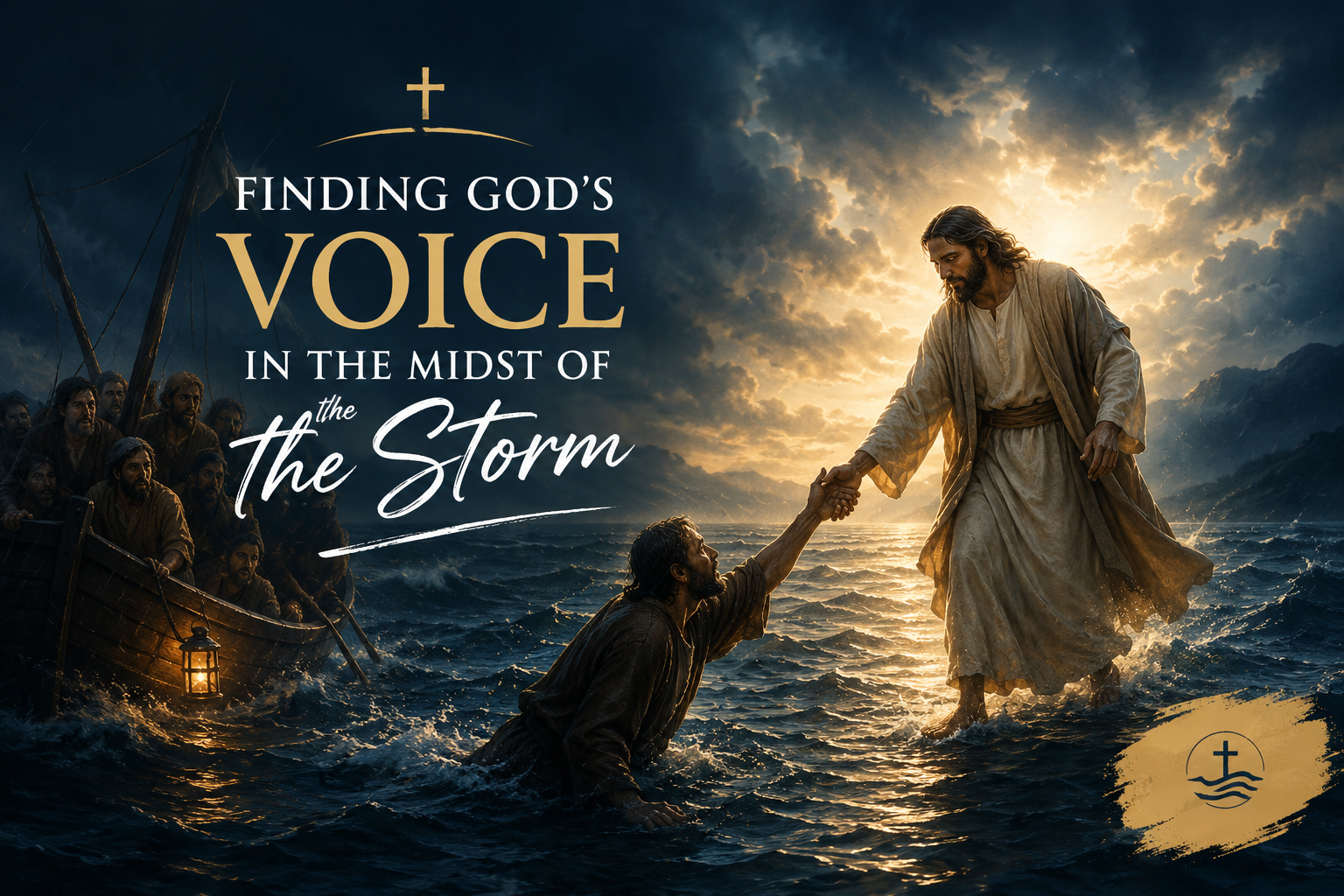
Finding God’s Voice in the Midst of the Storm
Readings: 1 Kings 19:9a, 11–13a | Romans 9:1–5 | Matthew 14:22–33
We all experience storms in life.
Some storms happen around us—illness, financial difficulties, family conflicts, or the loss of someone we love. Other storms happen within us—fear, anxiety, disappointment, loneliness, or uncertainty about the future.
During these moments, one question often arises:
Where is God?
Today’s readings answer that question with a beautiful truth: God is present even when He seems absent. The problem is not that God has stopped speaking; often it is that fear, noise, and suffering make it difficult for us to recognize Him.
God Speaks in the Whisper
The first reading presents one of the most profound moments in the Old Testament.
The prophet Elijah has just experienced great victories for God, yet he now finds himself discouraged and fleeing for his life. He reaches Mount Horeb—the very mountain where Moses encountered God.
God tells Elijah to stand on the mountain because the Lord is about to pass by.
Then extraordinary events occur.
A powerful wind tears through the mountains.
An earthquake shakes the ground.
A fire blazes before him.
Yet Scripture repeatedly says:
“The Lord was not in the wind… not in the earthquake… not in the fire.”
Finally comes “a tiny whispering sound”—literally, in Hebrew, “the sound of a gentle silence.” It is there that Elijah recognizes God’s presence.
This passage teaches an important spiritual lesson.
We often expect God to reveal Himself through extraordinary miracles or dramatic experiences. Yet God frequently speaks through silence, prayer, Sacred Scripture, the Eucharist, our conscience, or the quiet witness of another person.
The problem is not that God is silent.
The problem is that we are often surrounded by too much noise to hear His voice.
Fear Can Distort Our Vision
The Gospel presents another storm.
The disciples are alone in the boat while Jesus remains on the mountain in prayer. During the night, a violent wind arises, and the waves begin to overwhelm them.
Then Jesus comes walking on the water.
Instead of recognizing Him, the disciples cry out:
“It is a ghost!”
This is more than simple confusion.
Fear has distorted their vision.
Suffering often does the same to us.
When life becomes difficult, we may begin to misunderstand God Himself. We ask:
“Why has God abandoned me?”
“Does He still care about me?”
Yet the One we mistake for being absent is already coming toward us.
Jesus immediately speaks:
“Take courage, it is I; do not be afraid.”
These words echo God’s self-revelation throughout Scripture. The phrase “It is I” (Greek: ego eimi) recalls God’s divine presence and reassures the disciples that the Lord Himself is with them.
Peter’s Faith—and Ours
Peter then says,
“Lord, if it is You, command me to come to You on the water.”
Was Peter simply curious?
The Gospel suggests something deeper.
Peter trusts Jesus enough to leave the safety of the boat.
His first step is an act of faith.
And for a moment, he actually walks on water.
Then Matthew tells us something very important.
“Seeing how strong the wind was, he became frightened.”
Notice what changed.
The storm did not become stronger.
Jesus did not move away.
Only Peter’s focus changed.
He stopped looking at Christ and began looking at the storm.
The same thing happens in our spiritual lives.
Our problems often remain the same.
But when we fix our attention only on fear, suffering, or uncertainty, we begin to sink.
Faith does not mean pretending storms do not exist.
Faith means keeping our eyes on Christ while we pass through them.
Grace Is Faster Than Our Failure
Peter begins to sink and cries out,
“Lord, save me!”
Matthew immediately adds one beautiful word:
“Immediately.”
“Immediately Jesus stretched out His hand and caught him.”
Grace is quicker than our failure.
Jesus does not wait for Peter to become strong again.
He reaches out while Peter is still sinking.
That is how God works in our lives.
He meets us not only in moments of success but also in moments of weakness.
Elijah meets God when he is discouraged.
Peter meets Jesus most deeply when he realizes he cannot save himself.
Often, we hear God’s voice most clearly when we finally recognize how much we need Him.
The Pain in God’s Own Heart
The second reading may seem different, yet it reveals another aspect of God’s love.
St. Paul speaks with great sorrow for his own people, Israel. He would willingly suffer if it meant that they would come to know Christ.
This reflects something of God’s own heart.
God never stops loving His people, even when they fail to recognize Him.
Like Elijah, like Peter, and like Paul, we are invited to trust God’s faithfulness even when we cannot fully understand His plan.
Listening in the Midst of the Storm
Today’s readings leave us with three simple invitations.
First, learn to listen for God’s gentle voice. He often speaks in quiet and ordinary ways rather than through spectacular events.
Second, do not allow fear to define your vision. Fear made the disciples think Jesus was a ghost. Faith helps us recognize that Christ is already present in the middle of the storm.
Third, keep your eyes fixed on Christ. Storms are part of every human life, but they never have the final word. The One who says, “Take courage; it is I. Do not be afraid,” is always greater than the wind and the waves.
As we celebrate this Eucharist, let us bring before the Lord every storm we are facing. May we learn to hear His gentle voice amid the noise of the world. And when fear threatens to overwhelm us, may we keep our eyes fixed on Jesus, trusting that His hand is always stretched out to save those who call upon Him.
Amen.
Leave a Reply