
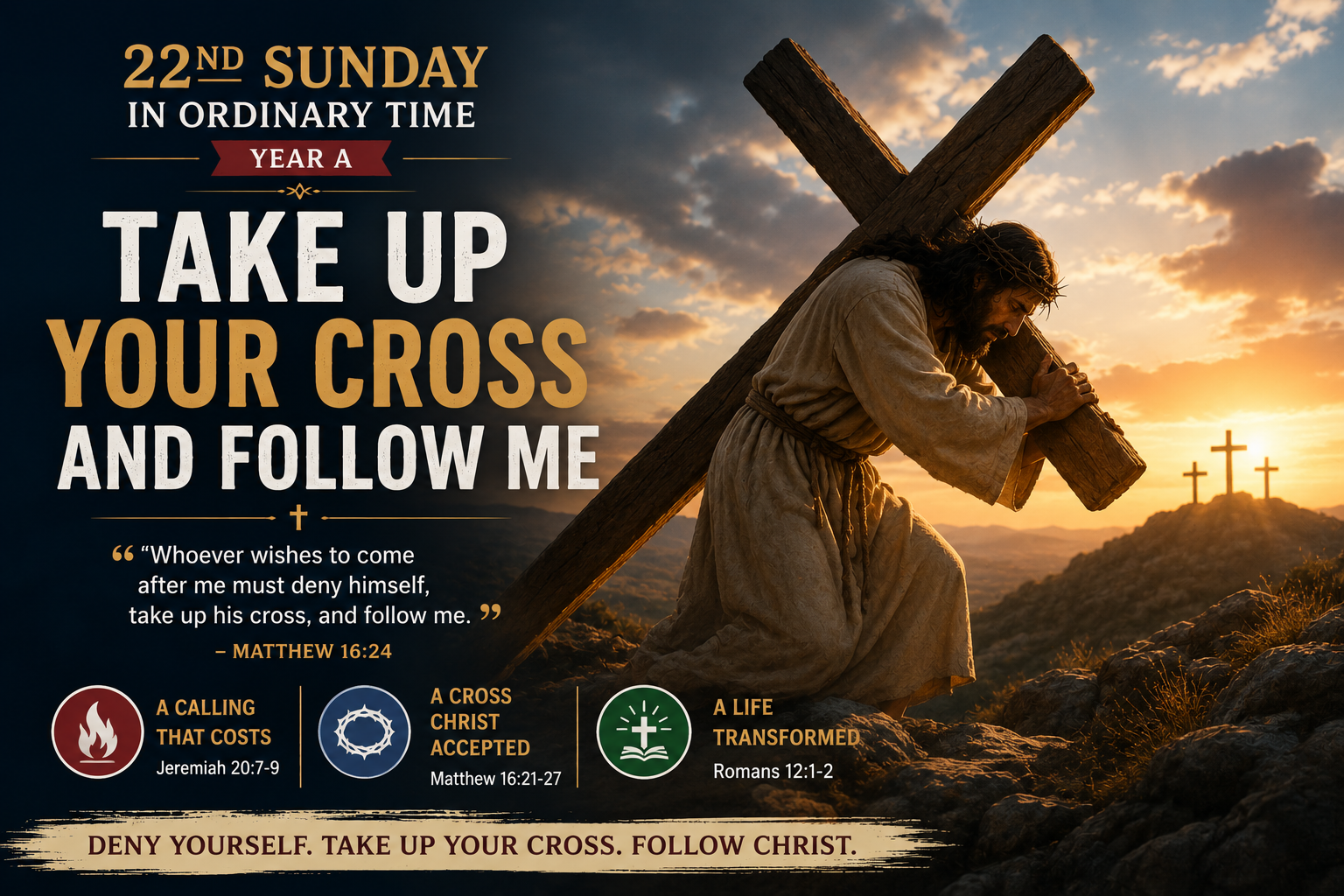
The Cross We Do Not Want
Readings: Jeremiah 20:7–9 | Romans 12:1–2 | Matthew 16:21–27
Dear brothers and sisters in Christ,
Who likes suffering?
None of us wakes up in the morning hoping for difficulties, rejection, disappointment, or pain. We naturally seek peace, comfort, and security. Yet in today’s Gospel, Jesus says words that challenge every generation of Christians:
“If anyone wants to become my follower, let him deny himself, take up his cross, and follow me.”
These words can easily be misunderstood. Christianity does not teach us to seek suffering for its own sake, nor does Jesus ask us to glorify pain. Rather, today’s readings help us understand that the cross is often the cost of remaining faithful to the vocation and mission that God has entrusted to us.
The first reading from Jeremiah gives us a powerful example.
Jeremiah had been called by God to be a prophet. But his mission brought him ridicule, opposition, and rejection. He became so discouraged that he cried out, “I have become a laughingstock all day long; everyone mocks me.” At one point, he even decided that he would no longer speak in God’s name.
Jeremiah had simply had enough.
Yet he discovered that he could not abandon his calling. God’s word became “like a fire burning in my heart.” Even though his mission caused suffering, he could not silence the truth entrusted to him.
Here we begin to understand the meaning of the cross.
Jeremiah’s cross was not merely that life was difficult. His cross was the hardship that came from remaining faithful to the vocation God had given him.
The Gospel continues this same theme.
There is a striking contrast with last Sunday’s Gospel. Last Sunday Peter made his great profession of faith: “You are the Christ, the Son of the living God.” Jesus praised him and called him blessed.
Today, however, Jesus begins to explain that the Messiah must go to Jerusalem, suffer, die, and rise again. Peter immediately objects: “God forbid it, Lord! This must never happen to you.”
Then Jesus says words that sound almost shocking: “Get behind me, Satan!”
What changed?
Peter still believes that Jesus is the Messiah. But he does not yet understand what kind of Messiah Jesus is. He wants Christ without the cross. He wants glory without suffering.
Perhaps this is one of the great struggles of Christian life.
We can profess our faith beautifully. We can say the Creed every Sunday. We can say, “Jesus is my Lord.” But when faith asks us to forgive, sacrifice, remain faithful, or choose truth over convenience, living that profession becomes much more difficult.
It is easier to profess faith than to live its consequences.
Jesus, however, does not ask His disciples to walk a road that He Himself refuses to walk. Before saying, “Take up your cross and follow me,” He announces His own suffering and death.
Jesus carries the cross first.
Only then does He invite us to follow Him.
This changes the meaning of discipleship. Christ is not standing at a distance asking us to endure what He Himself avoided. He enters fully into human suffering and transforms it through His love and obedience to the Father.
So what is our cross?
We sometimes call every inconvenience “my cross.” But today’s readings invite us to think more deeply.
Jeremiah’s cross came through faithfulness to his prophetic vocation. Jesus’ cross came through faithfulness to His saving mission.
Therefore, the Christian cross is especially the difficulty we encounter because we are trying to remain faithful to what God has called us to be.
For parents, it may mean the sacrifices made faithfully for their children.
For married couples, it may mean choosing forgiveness and fidelity when relationships become difficult.
For priests and religious, it may mean continuing to serve even when ministry becomes tiring or discouraging.
For every Christian, it may mean telling the truth when lying would be easier, forgiving when resentment seems more natural, or remaining faithful to the Gospel when compromise would be more comfortable.
St. Paul gives us the practical response in the second reading. He urges us to “present your bodies as a living sacrifice” and adds, “Do not be conformed to this world, but be transformed by the renewing of your minds.”
Taking up the cross also means refusing to allow the values of the world to determine our lives.
The world often says: choose what is easiest.
Christ says: choose what is faithful.
The world says: put yourself first.
Christ says: deny yourself.
The world says: avoid sacrifice at all costs.
Christ says: “Whoever loses his life for my sake will find it.”
This is the paradox at the heart of the Gospel. What appears to be loss becomes life. What seems to be weakness becomes strength. The cross, freely embraced in faith, becomes the path to resurrection.
Today’s readings therefore invite us to ask not simply, “What suffering do I have?” but, “How am I responding to the difficulties that come from being faithful to Christ and to the vocation God has given me?”
As we celebrate this Eucharist, let us ask for the courage of Jeremiah, who remained faithful even when his mission became painful. Let us learn from Peter that professing faith is only the beginning; we must also allow that faith to shape our lives. And above all, let us keep our eyes on Jesus, who carried the cross before asking us to follow Him.
May we have the grace to understand that the Christian cross is not a search for suffering, Readings: Jeremiah 20:7–9 | Romans 12:1–2 | Matthew 16:21–27
Dear brothers and sisters in Christ,
Who likes suffering?
None of us wakes up in the morning and says, “Today I would like to have some problems.” We naturally try to avoid pain, disappointment, rejection, and hardship. We want life to be peaceful and comfortable.
Yet in today’s Gospel, Jesus tells us:
“If anyone wants to become my follower, let him deny himself and take up his cross and follow me.”
Why does Jesus speak about the cross? Does Christianity teach us to search for suffering?
Certainly not.
To understand what Jesus means by taking up our cross, we need to listen carefully to all three readings.
Jeremiah and the Cost of His Calling
In the first reading, we meet Jeremiah at one of the lowest moments of his prophetic ministry.
God had called Jeremiah to be a prophet. But following that vocation brought him rejection, ridicule, opposition, and suffering. He cries:
“I have become a laughingstock all day long; everyone mocks me.”
Jeremiah becomes so discouraged that he decides:
“I will not mention him, or speak any more in his name.”
In other words, Jeremiah has had enough.
But then something happens. God’s Word becomes like a fire burning within his heart. Jeremiah tries to hold it back, but he cannot.
Here we begin to understand what the cross really means.
The cross is not simply every unpleasant thing that happens to us. The Christian cross is especially the cost of remaining faithful to the vocation and mission God has entrusted to us.
Jeremiah suffers because he remains faithful to his prophetic calling.
Peter Wants Christ Without the Cross
The Gospel gives us another powerful example.
There is almost an irony in what happens to Peter.
Last Sunday, we heard his great profession of faith:
“You are the Christ, the Son of the living God.”
Jesus praised him:
“Blessed are you, Simon son of Jonah.”
But today, immediately after that beautiful profession of faith, Jesus begins to speak about His suffering, death, and resurrection.
Peter cannot accept it.
He takes Jesus aside and says:
“God forbid it, Lord! This must never happen to you.”
Jesus responds with surprisingly strong words:
“Get behind me, Satan!”
Last Sunday: “Blessed are you.”
Today: “Get behind me, Satan.”
What happened?
Peter still believes that Jesus is the Messiah. But he does not yet understand what kind of Messiah Jesus is.
Peter wants Christ, but he does not want the cross.
And sometimes that is our struggle too.
We can profess our faith beautifully. We can recite the Creed every Sunday. We can say, “Jesus is my Lord.”
But living what we profess becomes much more difficult when discipleship demands sacrifice.
It is easier to profess faith than to live its consequences.
Jesus Carries the Cross First
There is something very important that we should never forget.
Jesus does not ask us to walk a road that He Himself refuses to walk.
Before saying,
“Take up your cross and follow me,”
Jesus announces His own cross.
He will go to Jerusalem. He will suffer. He will be killed. And He will be raised.
Jesus does not stand at a distance and point toward the cross.
He carries it first and then says, “Follow me.”
Christianity, therefore, is not simply a teaching about accepting suffering. It is following a Person who entered suffering Himself and transformed the cross into the path to resurrection.
What Is My Cross?
We sometimes call every inconvenience “my cross.”
A difficult neighbour, traffic, a bad day at work—we may quickly say, “This is my cross!”
But today’s readings invite us to understand the cross more deeply.
Jeremiah’s cross came through fidelity to his vocation.
Jesus’ cross came through fidelity to the Father’s saving mission.
So perhaps the better question is not simply:
“What difficulties do I have?”
But:
“What difficulties do I face because I am trying to remain faithful to what God has called me to be?”
For parents, the cross may involve sacrifices faithfully made for their children.
For married couples, it may mean remaining faithful, forgiving, and loving even when relationships become difficult.
For priests and religious, it may mean carrying the demands of their vocation when ministry becomes tiring or discouraging.
For every Christian, it may mean choosing truth when lying would be easier, forgiveness when resentment feels more natural, or faithfulness when compromise would be more comfortable.
The cross is not suffering for the sake of suffering. It is the cost that love and faithfulness sometimes ask of us.
Becoming a Living Sacrifice
This brings us to St. Paul’s words in the second reading:
“Present your bodies as a living sacrifice, holy and acceptable to God.”
Then he adds:
“Do not be conformed to this world, but be transformed by the renewing of your minds.”
Taking up the cross, therefore, also means refusing to allow the values of the world to determine the direction of our lives.
The world may say: Choose what is easiest.
Christ says: Choose what is faithful.
The world may say: Put yourself first.
Christ says: Deny yourself.
The world may say: Avoid sacrifice at any cost.
Christ says:
“Whoever loses his life for my sake will find it.”
This is the great paradox of the Gospel: in giving ourselves, we discover ourselves; in sacrificing out of love, we discover a deeper life; and through the cross, we journey toward resurrection.
Today, therefore, Jesus is not asking us to go looking for suffering.
He is asking something more challenging:
When faithfulness becomes difficult, will we still follow Him?
Jeremiah remained faithful to his calling.
Peter had to learn that professing Christ also meant accepting the way of the cross.
And Jesus Himself walked that way before asking any of us to follow.
As we celebrate this Eucharist, let us ask for the grace not merely to profess our faith when it is easy, but to live it when it costs us something.
And when the cross comes through our faithful response to God’s call, may we hear Jesus walking before us and saying:
“Take up your cross and follow me.”but the cost we sometimes pay for remaining faithful to Christ.
Amen.
Leave a Reply