
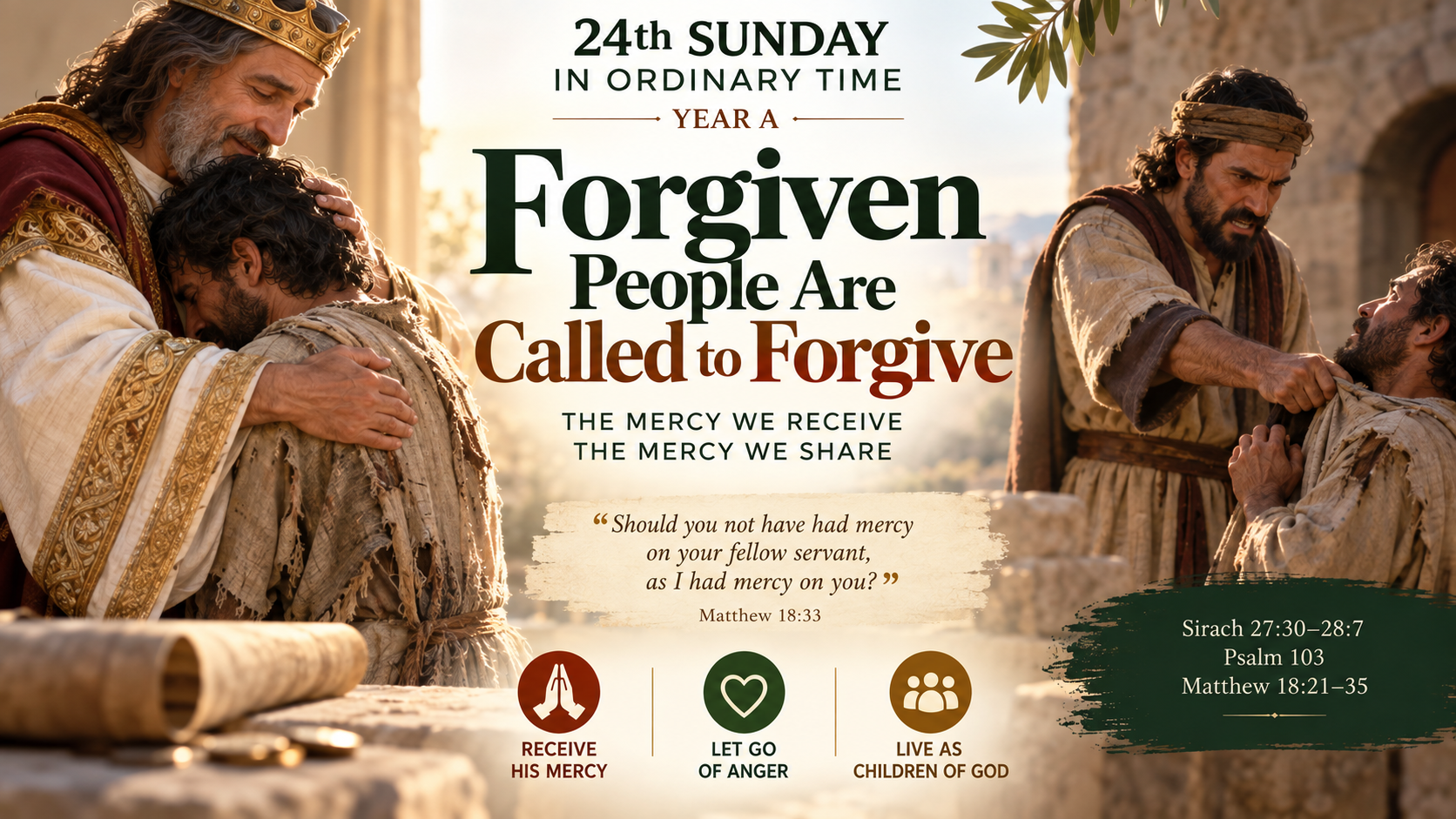
Forgiven People Are Called to Forgive
Readings: Sirach 27:30–28:7 | Romans 14:7–9 | Matthew 18:21–35
Dear brothers and sisters in Christ,
Very little of what we have today began with us.
Our life itself is a gift. The faith we received, the family that formed us, the people who educated us, the sacrifices others made for us, the opportunities we received—behind what we call “my life” stand countless gifts and countless people.
Ultimately, behind them all stands God Himself.
Yet we sometimes live as though everything belongs to us and everything is the result of our own effort. We easily forget how much we have received.
Gratitude changes this attitude. It reminds us that life is not simply something we possess; life is something we have received.
And this truth gives us a beautiful way to understand today’s readings, especially the difficult question of forgiveness.
How Much Should I Forgive?
Peter comes to Jesus with a very practical question:
“Lord, if my brother sins against me, how often must I forgive him? As many as seven times?”
Peter probably thought seven times was already very generous.
But Jesus answers:
“Not seven times, but seventy-seven times.”
Jesus is obviously not asking Peter to carry a notebook and count until he reaches seventy-seven.
He is saying that Christian forgiveness cannot be reduced to a calculation.
Love does not ask, “How many more times am I required to forgive?”
It asks, “How can I continue to live as a person who has received mercy?”
And that brings us to the more important question.
Not simply:
How much should I forgive?
But:
Why should I forgive?
Remember What You Have Received
Jesus answers with the parable of the unforgiving servant.
A servant owes his king an enormous debt—a debt beyond his ability to repay. He begs for patience.
But the king does something far greater than the servant requests.
He does not simply give him more time.
He forgives the entire debt.
The servant walks away free.
Then he meets another servant who owes him a much smaller amount. But instead of extending the mercy he has just received, he grabs the man and demands payment.
This is the tragedy of the parable.
The servant received mercy but did not allow mercy to change him.
He wanted forgiveness for himself but justice without mercy for someone else.
Jesus therefore gives us the deepest reason for Christian forgiveness:
We forgive because we ourselves have been forgiven.
Sirach: Remember, and Let Go
The first reading from Sirach gives the same message in very direct language:
“Forgive your neighbour’s injustice; then when you pray, your own sins will be forgiven.”
And Sirach asks a challenging question:
“Could anyone nourish anger against another and expect healing from the Lord?”
In other words, how can I continually stand before God saying, “Lord, have mercy on me,” while refusing even to consider mercy toward another person?
Sirach repeatedly tells us to remember.
Remember the commandments.
Remember the covenant.
Remember the end of life.
And, we might add in the light of the Gospel: remember the mercy you have already received.
Sometimes forgiveness begins not by forgetting what another person did to us, but by remembering what God has done for us.
The Lord Is Merciful and Gracious
Today’s Psalm gives us the foundation:
“The Lord is merciful and gracious, slow to anger and abounding in steadfast love.”
It continues:
“He does not deal with us according to our sins, nor repay us according to our faults.”
This is our God.
Every time we approach the Sacrament of Reconciliation, we stand before this mercy.
How many times have we brought the same weaknesses before God?
How many times have we promised to change and then fallen again?
Yet God continues to call us back.
God’s mercy does not mean that sin is unimportant. It means that our sin does not exhaust His desire to restore us.
Children Should Resemble Their Father
But there is another dimension to forgiveness.
We are not simply people who owe everything to God.
Through Christ, God has made us His children.
And a child should gradually come to resemble the Father.
Jesus tells us elsewhere:
“Be merciful, just as your Father is merciful.”
Therefore, forgiveness is not simply paying back a debt to God: “God forgave me, so now I have to forgive someone else.”
It is something deeper.
Forgiveness reveals whose children we are.
If our Father is merciful, His mercy should gradually become visible in us.
If He is patient with us, we should learn patience.
If He gives another opportunity, we should become people capable of giving another opportunity.
If He forgives, His children must learn to forgive.
Forgiveness Is Not Pretending Nothing Happened
Of course, forgiveness does not mean pretending that we were never hurt.
It does not mean saying that injustice was acceptable.
And it does not always mean restoring a relationship exactly as it was before. Sometimes wisdom requires boundaries.
Forgiveness means refusing to allow another person’s wrongdoing to turn our hearts into a permanent home for resentment and hatred.
We place justice in God’s hands and ask Him to free our hearts.
That can take time.
Sometimes forgiveness begins simply with the prayer:
“Lord, I am not yet able to forgive fully, but help me to desire to forgive.”
That itself can be the beginning of healing.
Dear brothers and sisters,
today Peter asks:
“How often must I forgive?”
But Jesus leads us to a deeper question:
“How much have I already been forgiven?”
When we remember the mercy we have received, forgiveness begins to look different.
Everything we have is gift.
Our life is gift.
Our faith is gift.
God’s mercy is gift.
And because we are children of a merciful Father, our lives should gradually reveal the character of our Father.
As we celebrate this Eucharist, let us remember with gratitude all that we have received. And especially, let us remember how patiently and generously God has forgiven us.
Then may we ask for the grace to become what we have received:
people of mercy, people of gratitude, and people who know how to forgive.
Amen.
Leave a Reply