
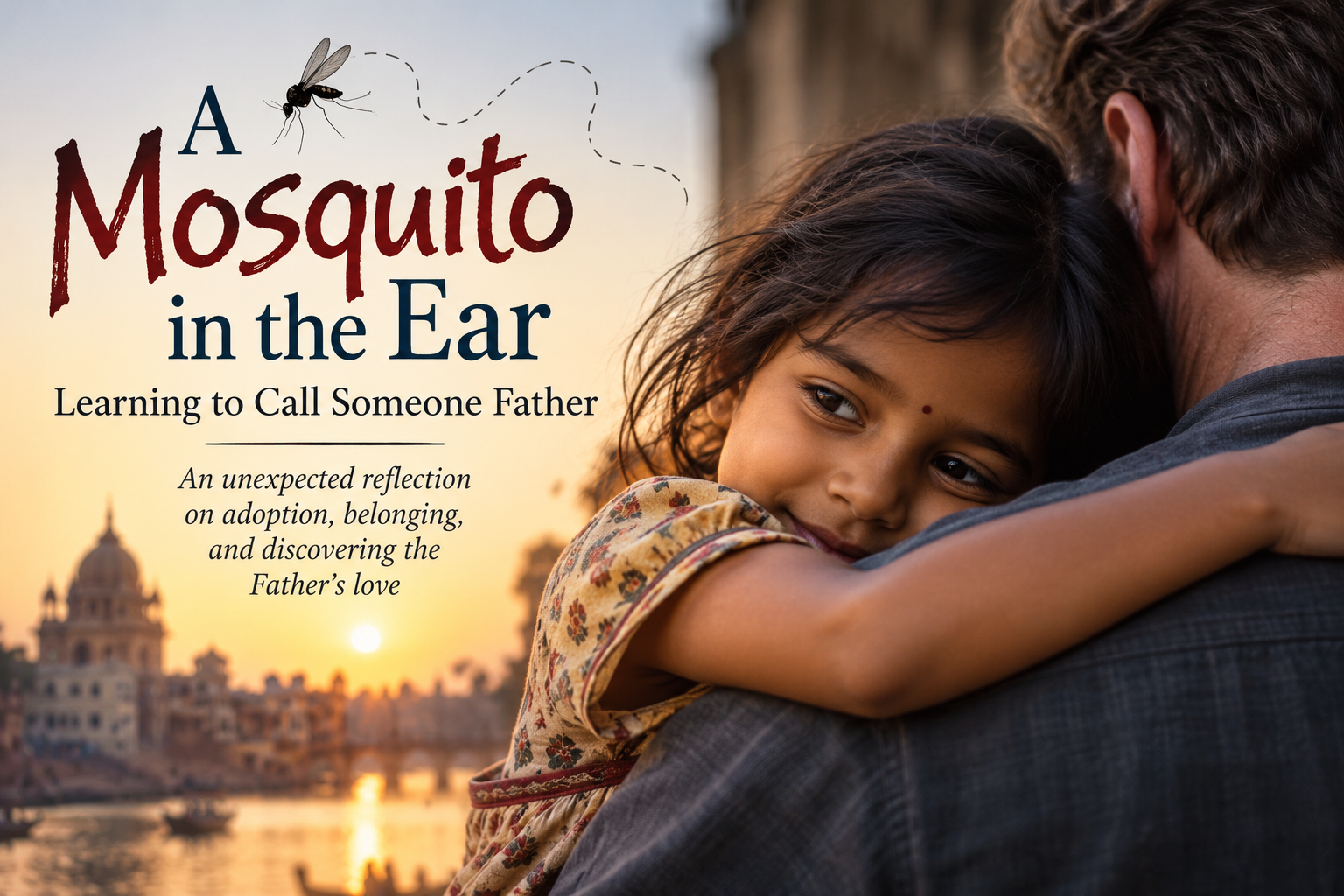
An unexpected reflection on adoption, belonging, and discovering the Father’s love
Faith & Cinema | Film Reflection · Contains Spoilers
⚠️ Spoiler Alert: This reflection discusses important scenes and reveals key developments in A Mosquito in the Ear, including its emotional turning point. If you haven’t watched the film yet, you may prefer to return to this article afterward.
Nobody Likes to Be Adopted
“Nobody likes to be adopted.”
What a strange statement!
Especially when it comes from a sister who has dedicated her life to caring for children in an orphanage.
Yet these words, spoken in A Mosquito in the Ear, reveal something important about the film’s little protagonist, Sarvari.
Directed by Nicola Rinciari and inspired by a true story recounted in Andrea Ferraris’ graphic novel, the film follows an American couple, Andrew and Daniela, who travel to India to adopt a four-year-old girl.
For the couple, it is the beginning of a long-awaited dream. They are ready to offer her a home, affection, security, and a future filled with possibilities.
From the outside, everything appears beautiful.
A little girl is leaving an orphanage to become part of a loving family. Surely, she should be happy.
But Sarvari is not happy.
She resists their affection, refuses their attempts to make her comfortable, and desperately wants to remain in the only place she knows.
What appears to others as a wonderful opportunity feels to her like an enormous loss.
And perhaps that is where this simple film begins to reveal something profound about love, belonging, and the human heart.
The World We Are Afraid to Leave
For Andrew and Daniela, the orphanage is a place from which they are bringing Sarvari into a better future.
For Sarvari, it is home.
The sisters are familiar faces. The other children are her companions. The language, surroundings, and daily routines are part of the world in which she feels secure.
Now she must leave everything behind and follow two strangers.
We may understand the parents’ excitement, but the film quietly asks us to see the situation through the child’s eyes.
A better future does not necessarily make the loss of a familiar present less painful.
There is something deeply human in Sarvari’s resistance.
We often hesitate before change, even when it promises something good. We become attached to familiar situations, habits, and relationships. Sometimes we remain where we are, not because we are completely happy, but because the unknown frightens us.
Sarvari’s struggle is more than an ordinary reluctance to change. She is a young child facing separation from the people and surroundings she trusts.
Her resistance deserves understanding rather than judgment.
The parents gradually discover that welcoming a child into their family involves more than providing a home.
They must learn to see the world through her eyes.
A Mosquito in the Ear
The film’s unusual title captures Sarvari’s experience beautifully.
Andrew and Daniela speak English, a language she does not understand.
They talk to her, explain things, and try to express their affection. But to Sarvari, their unfamiliar words are like the irritating buzzing of a mosquito near her ear.
What the parents intend as communication becomes another source of frustration for the child.
It is a striking image of the distance between good intentions and genuine understanding.
The parents know what they want to communicate. But Sarvari cannot receive their words in the way they intend.
Their affection is sincere, yet sincerity alone cannot remove her fear.
How often does something similar happen in our relationships?
We try to help someone, believing that we know what is best. We offer advice, explanations, or solutions. Sometimes we become frustrated when the other person does not respond as we expect.
But perhaps we have not yet understood their world.
The film reminds us that love is not simply about what we are willing to give. It is also about recognizing what another person is able to receive.
And sometimes love must learn to speak without words.
The Dress She Would Not Change
One small detail in the film particularly caught my attention.
Sarvari refuses to change the dress she wore when she left the orphanage.
Her parents offer her new clothes and experiences. They try different ways to make her comfortable, but she continues wearing the same dress.
At first, it might seem like childish stubbornness.
Yet that dress carries a meaning beyond its appearance.
Almost everything in Sarvari’s life has changed. She is surrounded by unfamiliar people, places, and sounds.
But her dress remains the same.
It belongs to the world she knows.
Perhaps it is one of the few things she can still hold on to.
We all have things that connect us to our past. An old photograph, a familiar object, or a childhood memory may seem insignificant to others but carry enormous meaning for us.
Sometimes we hold on to these things because they remind us of who we are.
Sarvari’s dress becomes a quiet symbol of her attachment to a world she is not ready to leave.
Her parents can offer her something new, but they cannot force her to feel ready for it.
Something deeper must happen first.
When Love Becomes Visible
The film’s emotional turning point comes when Sarvari runs away from the hotel.
Her parents are terrified.
They search desperately for her, and during the incident both Sarvari and her father are injured.
Later, there is a quiet scene that I found particularly moving.
Daniela tends to the father’s wounded hand.
Sarvari watches.
Nothing extraordinary seems to be happening. A woman is caring for her husband’s injury while a little girl observes.
But the scene carries a meaning that words could hardly express.
Sarvari has already seen her new parents trying to make her happy. They have offered affection, comfort, and things they believe she might enjoy.
Now she witnesses something different.
She sees the wound of a man who has been desperately searching for her.
She sees the tenderness of a woman caring for him.
For a moment, she is no longer simply the child receiving their attention. She is watching the love that exists between these two people.
And perhaps she begins to recognize something of that love for herself.
The father has not delivered a speech about how much he loves her.
He has not explained the advantages of becoming his daughter.
His actions have spoken.
He was frightened of losing her.
He searched for her.
He was hurt in the process.
And Sarvari has seen it.
Then comes one of the film’s most beautiful moments.
She rests on her father’s shoulder.
A little girl who had struggled to accept this unfamiliar man begins to find comfort in his presence.
The moment is simple, almost silent.
But it reveals a profound change.
The legal process of adoption had already taken place. Andrew and Daniela had already welcomed Sarvari as their daughter.
Yet something remained unfinished within her.
She was already adopted, but she had not yet discovered what it meant to be loved as a daughter.
Watching this scene, I found myself thinking about a beautiful truth of Christian faith.
We Are Also Adopted Children
St. Paul writes:
“You have received a spirit of adoption, through which we cry, ‘Abba, Father!’” (Romans 8:15).
One of the extraordinary gifts of Christianity is that we are invited to become children of God through Jesus Christ.
St. Paul expresses this mystery again in Galatians 4:4–7. God sent His Son so that we might receive adoption as children, and through the Spirit we can call God our Father.
Through baptism, we receive this new identity.
We become members of God’s family, sharing in the life of Christ.
For many of us, this happened when we were infants.
We grew up learning that God is our Father. We learned the Our Father, attended Mass, received the sacraments, and studied the teachings of the Church.
We know that we are God’s children.
But I wonder whether knowing this truth and experiencing its meaning are always the same thing.
We may believe that God loves us while finding it difficult to trust Him.
We may call Him Father in prayer but approach Him with the fear of someone who is uncertain of being accepted.
We may know the teachings of our faith without allowing them to shape the way we see ourselves.
Sarvari’s journey offers an interesting parallel.
Her parents have already accepted her, but she is still learning what their love means.
Similarly, through baptism, we have received the gift of divine adoption. Yet growing into that identity is a lifelong journey.
Of course, the two experiences are not identical. Sarvari has good reasons to fear an unfamiliar situation, and her parents must patiently earn her trust. God’s love, unlike human love, is already perfect and faithful.
Nevertheless, her story invites us to consider a personal question:
We know that God is our Father. But have we truly discovered what it means to be His beloved children?
The Father Whose Love We Can See
There is another beautiful connection between Sarvari’s experience and our Christian faith.
At first, she struggles to understand her new father’s language.
His words are unfamiliar. His intentions are difficult for her to recognize.
But through his actions, she begins to understand something that words alone could not communicate.
This reminded me of a question at the heart of Christianity.
How do we come to know the love of our heavenly Father?
Jesus gives us an answer.
When Philip asks Him to show them the Father, Jesus replies:
“Whoever has seen me has seen the Father” (John 14:9).
In Jesus Christ, the love of God becomes visible.
We see it in His compassion toward the suffering, His forgiveness of sinners, His tenderness toward the forgotten, and ultimately in His willingness to give His life for humanity.
The Gospel of John expresses this mystery in a few remarkable words:
“The Word became flesh and made his dwelling among us.” (John 1:14).
God’s love is not merely an idea we are asked to accept.
In Jesus, that love enters human history.
Sarvari begins to recognize her father’s love through his actions, particularly through the suffering he experiences while searching for her.
For a Christian viewer, the scene may quietly recall the love revealed through Christ’s sacrifice.
The father’s wounded hand is not a direct symbol of the Cross. But genuine human love, especially when it involves sacrifice, can sometimes help us recognize something of the mystery of divine love.
St. John writes:
“We love because he first loved us.” (1 John 4:19).
That is the foundation of our relationship with God.
We do not have to persuade God to love us.
His love comes first.
Our journey is one of discovering, accepting, and responding to that love.
A New Dress
Toward the end of the film, Sarvari finally becomes willing to change the dress she had refused to remove.
It is a small gesture, but it completes a beautiful movement within the story.
Earlier, her parents had offered her new clothes, but she was not ready to accept them.
Now something has changed.
Not the clothes.
Not the promises.
But her relationship with the people offering them.
She has begun to trust.
And that trust makes change possible.
I found this moment particularly meaningful in the light of St. Paul’s invitation to put away the old self and put on the new self (Ephesians 4:22–24).
Sarvari’s old dress is not a symbol of sin. It represents familiarity and the security of her former world.
Yet her willingness to change provides a gentle image of the transformation that can take place in our spiritual lives.
We sometimes imagine Christian conversion mainly as a matter of changing our behaviour.
We must correct our mistakes, abandon sinful habits, and become better people.
These changes are important.
But Christian transformation is not simply an external adjustment.
It grows from our relationship with God.
When we discover His mercy, we become more willing to acknowledge our failures.
When we experience His faithfulness, we find the courage to trust.
When we recognize ourselves as His beloved children, we begin to live differently.
The change in our lives becomes a response to love rather than an attempt to earn it.
Sarvari does not change in order to become loved. She changes because she has begun to experience love.
Perhaps there is something of our own Christian journey in that simple gesture.
Learning to Call Someone Father
A Mosquito in the Ear is not a film that offers easy answers about adoption or family life.
It portrays the beginning of a relationship that requires patience, understanding, and trust.
The parents must learn that love cannot be imposed.
Sarvari needs time to discover that these unfamiliar people genuinely care for her.
The film does not suggest that every difficulty disappears when she finally accepts her father’s embrace. Becoming a family is a journey, and trust must continue to grow.
But something important has begun.
The little girl who once found her father’s unfamiliar words as irritating as a mosquito buzzing in her ear now rests quietly on his shoulder.
Perhaps she still cannot understand everything he says.
But she has begun to understand something far more important.
She is loved.
And perhaps this is where the film leaves us with a question that reaches beyond its story.
We have been welcomed into God’s family through Christ.
We have learned to call Him Father.
But how many of us are still learning to trust Him with the confidence of a beloved child?
Perhaps faith is not always about finding new words to describe God.
Sometimes it is about discovering the love that has been reaching out to us all along.
And perhaps, like Sarvari, we are still learning to rest on the Father’s shoulder.
Faith & Cinema — Finding deeper meaning in the stories we watch.
Leave a Reply