
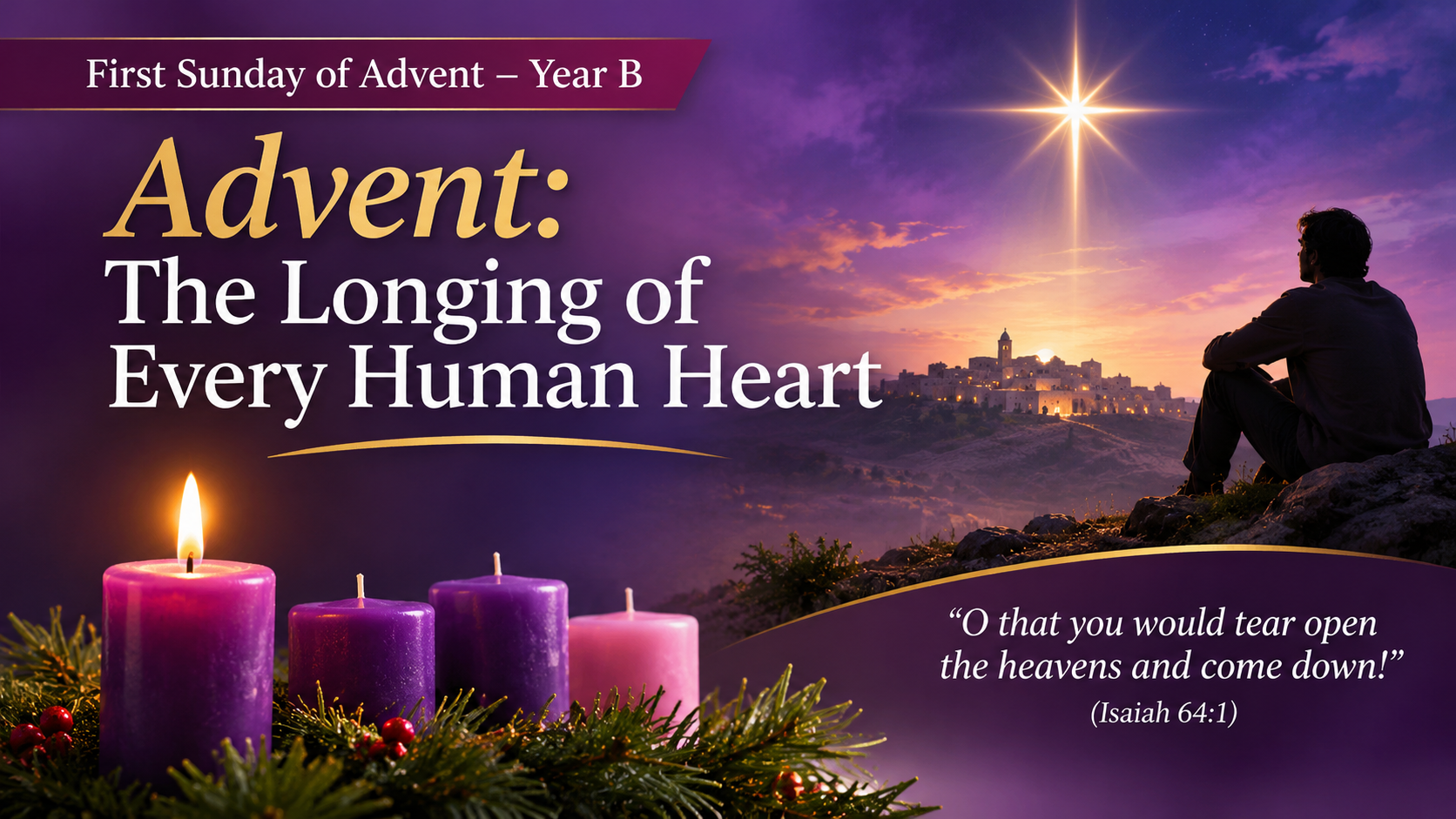
First Sunday of Advent – Year B | November 29, 2026
Readings: Isaiah 63:16b–17; 64:1, 3–8 | Psalm 80 | 1 Corinthians 1:3–9 | Mark 13:33–37
Humanity’s Longing for a Saviour
The history of humanity is, in many ways, a history of longing for salvation. When there is oppression, humanity looks for a liberator; when there is disease, it searches for healing; when there is war, it longs for peace.
What we see in human history, we also experience in our personal lives. From childhood to old age, we search for someone or something that can liberate us from our difficulties and fulfil our deepest desires.
Today, as we begin the season of Advent, the prophet Isaiah gives voice to this universal human longing:
“O that you would tear open the heavens and come down!” (Isaiah 64:1).
Israel’s Story Is Our Story
In a time of communal devastation and estrangement from God, the people of Israel acknowledge their unfaithfulness, appeal to God as their Father and Redeemer, and cry out for his saving presence.
Their prayer reflects a recurring experience in Israel’s biblical history. When the Israelites suffered under slavery in Egypt, they cried out to God, and God liberated them through Moses (Exodus 3:7–10). Yet, even after experiencing his saving power, they struggled to remain faithful.
In the Book of Judges, we encounter a recurring pattern of unfaithfulness, oppression, repentance and deliverance (Judges 2:11–19).
Is this not something we also recognize in human history and in our own lives?
When everything is going well, we may begin to feel self-sufficient. When difficulties arise, we rediscover our vulnerability. Even in our spiritual lives, we sometimes fall into sin, seek forgiveness, experience God’s mercy and gradually become spiritually careless again.
This does not mean that every experience of suffering is a consequence of personal sin. Nevertheless, our experiences often reveal the limitations of our own strength.
Israel’s history becomes a mirror in which we recognize both the history of humanity and our own spiritual journey.
A Prayer for Every Sinner
What makes Isaiah’s prayer particularly beautiful is that, despite acknowledging their sinfulness, the people have not lost confidence in their relationship with God.
They still call him their Father. They recognize that he is the potter and they are the clay (Isaiah 64:8).
This is a beautiful prayer for everyone struggling with sin. Sometimes, because of our weaknesses, we hesitate to approach God. We think that we must first overcome our sinful habits before returning to him.
But the clay cannot reshape itself without the potter.
We approach God precisely because we need his grace.
The responsorial psalm expresses this same hope as it asks God to restore his people and let his face shine upon them (Psalm 80).
Beneath our many human desires lies a deeper longing for God himself. The Catechism of the Catholic Church teaches that the desire for God is written in the human heart (CCC 27). St. Augustine reminds us that our hearts remain restless until they find their rest in God (Confessions, I, 1).
Advent begins not with a declaration of our perfection, but with an acknowledgement of our need for a Saviour.
Advent: God’s Response to Human Longing
Christianity is not simply the story of humanity searching for God. It is also the story of God coming in search of humanity.
From the moment God calls out to Adam in the garden, asking, “Where are you?” (Genesis 3:9), Scripture reveals a God who seeks his children. Through Abraham, Moses and the prophets, God gradually prepares his people for the coming of the Messiah (CCC 522–524).
Isaiah pleads with God to come down. Christmas celebrates the mystery of God coming to dwell among us.
In Jesus Christ, God does more than send another prophet: the eternal Son himself comes to dwell among us (John 1:14).
This is why Advent is a season of joyful expectation.
The Church teaches that through the annual celebration of Advent, we participate in the ancient expectation of the Messiah and renew our longing for Christ’s second coming (CCC 524).
We celebrate his first coming in humility and await his second coming in glory.
Christ has won the victory over sin and death through his death and resurrection; we await the full manifestation of that victory at his return (CCC 671).
In today’s second reading, St. Paul assures us that God, who has enriched us through Christ, will sustain us as we await his return (1 Corinthians 1:3–9).
Our preparation, therefore, is not simply a human effort. It is a response to the grace and faithfulness of God.
Stay Awake: The Christian Way of Living
There is something particularly meaningful about the way the Church arranges her liturgical year.
Last Sunday, as we celebrated the Solemnity of Christ the King, the Church directed our attention towards Christ’s glorious return and the final judgment. Today, as we begin a new liturgical year, Jesus once again invites us to remain watchful.
The Church begins and ends her liturgical year with an invitation to be prepared.
Why? Because preparation for our encounter with Christ is not merely an Advent activity. It is the very nature of Christian life.
In today’s Gospel, Jesus speaks of a man who leaves his house, entrusting each servant with a particular responsibility and instructing the doorkeeper to remain watchful (Mark 13:33–37).
The servants are not asked to abandon their responsibilities in order to wait for their master. Their faithfulness to the work entrusted to them is itself part of their preparation.
Christian watchfulness is not anxious waiting but faithful living.
For someone caring for an elderly parent, for example, preparation for the coming of Christ may mean carrying out that responsibility with greater patience, tenderness and love.
We prepare for the Lord not by withdrawing from our ordinary lives, but by living them faithfully in his presence.
Human history is not an endless cycle of longing and disappointment. It is moving towards its definitive fulfilment in Christ.
Preparing Our Hearts for Christ
During the coming weeks, many of us will prepare our homes for Christmas. We will decorate, purchase gifts, organize gatherings and make plans to celebrate with those we love.
These are beautiful expressions of Christmas joy. But amid all these preparations, Advent invites us to look within ourselves.
What am I longing for at this moment in my life? Where am I searching for happiness and fulfilment? Is there a sinful habit from which I need liberation or a wounded relationship that needs healing?
Perhaps this Advent is an opportunity to return to the Sacrament of Reconciliation, renew our commitment to prayer, deepen our participation in the Eucharist or extend forgiveness to someone.
It is not enough to recognize that humanity needs a Saviour. I must recognize that I need a Saviour.
It is not enough to celebrate that Christ entered human history. I must allow him to transform my personal history.
It is not enough to believe that Christ will come again. I must live in readiness to encounter him.
Come, Lord Jesus
Advent is not simply a countdown to Christmas. It is a reminder of the direction of our entire Christian life.
Let the prayer of Isaiah become our personal prayer during this Advent:
Lord, we have wandered away from you. We have our weaknesses, our failures and our sinful habits. Yet you are our Father. You are the potter, and we are the clay. Come into our lives and reshape us according to your will.
May this Advent be not merely a preparation for a beautiful Christmas, but a renewed encounter with the Saviour for whom every human heart longs.
Come, Lord Jesus! (Revelation 22:20)
Amen.
Leave a Reply